Residuals
Usage
# S3 method for class 'cv.corila'
residuals(object, ...)
Arguments
- object
object of class
"cv.corila"- ...
(for compatibility with stats::residuals)
Details
This function extracts the observed and fitted values from the fitted model
and calls the internal function .residuals() to calculate the residuals.
Examples
# listing S3 methods
methods(class = "cv.corila")
#> [1] coef deviance fitted nobs plot predict print
#> [8] residuals summary
#> see '?methods' for accessing help and source code
# simulating data
n <- 10L; p <- 20L; q <- 5L
x <- matrix(rnorm(n * p), nrow = n , ncol = p)
y <- rnorm(n)
group <- rep(seq_len(q), length.out = p)
primary <- as.logical(rbinom(n = p, size = 1L, prob = 0.5))
# fitting the model
object <- cv.corila(x = x, y = y, group = group, primary = primary)
#> Warning: Option grouped=FALSE enforced in cv.glmnet, since < 3 observations per fold
#> wgt_local exp_local wgt_global exp_global threshold cvm
#> 11 1 0 0 Inf 0 1.792635
# using S3 methods
coef(object)
#> (intercept) <NA> <NA> <NA> <NA> <NA>
#> 0.1910942 -0.4528897 0.0000000 0.0000000 0.0000000 0.0000000
#> <NA> <NA> <NA> <NA> <NA> <NA>
#> 0.0000000 0.0000000 0.0000000 -0.2268216 0.0000000 0.0000000
#> <NA> <NA> <NA> <NA> <NA> <NA>
#> 0.0000000 0.0000000 0.0000000 0.0000000 0.0000000 0.0000000
#> <NA> <NA> <NA>
#> 0.0000000 0.0000000 0.0000000
predict(object, newx = x)
#> [1] -0.186875744 0.816536087 0.461487360 -0.302035846 0.296781032
#> [6] 0.418972095 0.009587133 -0.740386858 0.045254514 0.648661414
fitted(object)
#> [1] -0.186875744 0.816536087 0.461487360 -0.302035846 0.296781032
#> [6] 0.418972095 0.009587133 -0.740386858 0.045254514 0.648661414
residuals(object)
#> [1] -0.53418090 0.19316925 0.35717618 -0.18173426 -0.28458351 1.49568597
#> [7] 0.35078531 -0.60900795 -0.03311259 -0.75419750
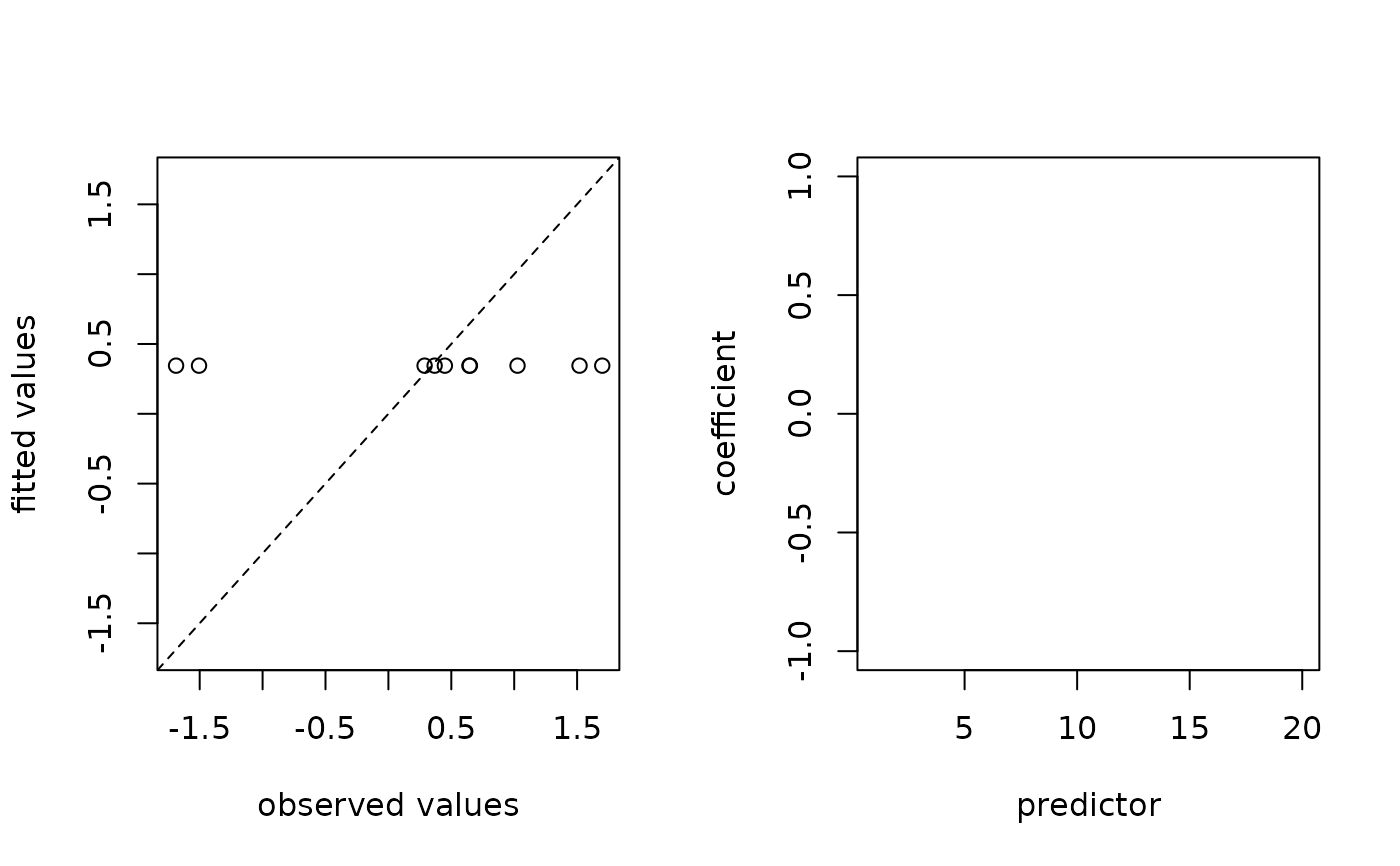
plot(object)
 print(object)
#> object of class ‘cv.corila’
#> (contains multiple objects of class ‘cv.glmnet’)
#> selected 2 from 20 predictors
summary(object)
#> --- object of class “cv.corila” ---
#> generalised linear model with gaussian family
#> 20 features (10 primary and 10 auxiliary features)
#> initial coefficients: ridge regression
#> final coefficients: adaptive lasso regression
#> optimised regularisation parameter: lambda.min = 0.3004
#> selected weights: local = 1, global = 0
#> selected exponents: local = 0, global = Inf
#> 3 non-zero coefficients (including intercept)
print(object)
#> object of class ‘cv.corila’
#> (contains multiple objects of class ‘cv.glmnet’)
#> selected 2 from 20 predictors
summary(object)
#> --- object of class “cv.corila” ---
#> generalised linear model with gaussian family
#> 20 features (10 primary and 10 auxiliary features)
#> initial coefficients: ridge regression
#> final coefficients: adaptive lasso regression
#> optimised regularisation parameter: lambda.min = 0.3004
#> selected weights: local = 1, global = 0
#> selected exponents: local = 0, global = Inf
#> 3 non-zero coefficients (including intercept)