Calculates the deviance.
Usage
# S3 method for class 'cv.corila'
deviance(object, ...)
Arguments
- object
object of class
"cv.corila"- ...
(for compatibility with stats::deviance)
Details
Returns the deviance calculated by glmnet::deviance.glmnet()
for the model with the optimised mixing and regularisation hyperparameters.
See also
The internal function .deviance() calculates
the deviance from fitted and observed values.
Examples
# listing S3 methods
methods(class = "cv.corila")
#> [1] coef deviance fitted nobs plot predict print
#> [8] residuals summary
#> see '?methods' for accessing help and source code
# simulating data
n <- 10L; p <- 20L; q <- 5L
x <- matrix(rnorm(n * p), nrow = n , ncol = p)
y <- rnorm(n)
group <- rep(seq_len(q), length.out = p)
primary <- as.logical(rbinom(n = p, size = 1L, prob = 0.5))
# fitting the model
object <- cv.corila(x = x, y = y, group = group, primary = primary)
#> Warning: Option grouped=FALSE enforced in cv.glmnet, since < 3 observations per fold
#> wgt_local exp_local wgt_global exp_global threshold cvm
#> 3 0.2 0 0.8 2 0 1.861687
# using S3 methods
coef(object)
#> (intercept) <NA> <NA> <NA> <NA> <NA>
#> -0.4934846 0.0000000 0.0000000 0.0000000 0.0000000 0.0000000
#> <NA> <NA> <NA> <NA> <NA> <NA>
#> 0.0000000 0.0000000 0.0000000 0.0000000 0.0000000 0.0000000
#> <NA> <NA> <NA> <NA> <NA> <NA>
#> 0.0000000 0.0000000 0.0000000 0.0000000 0.0000000 0.0000000
#> <NA> <NA> <NA>
#> 0.0000000 0.0000000 0.0000000
predict(object, newx = x)
#> [1] -0.4934846 -0.4934846 -0.4934846 -0.4934846 -0.4934846 -0.4934846
#> [7] -0.4934846 -0.4934846 -0.4934846 -0.4934846
fitted(object)
#> [1] -0.4934846 -0.4934846 -0.4934846 -0.4934846 -0.4934846 -0.4934846
#> [7] -0.4934846 -0.4934846 -0.4934846 -0.4934846
residuals(object)
#> [1] -0.18455606 0.02012657 1.52090170 -0.10390295 1.65333399 -0.83974226
#> [7] -0.43227104 -0.58101051 -0.95763188 -0.09524755
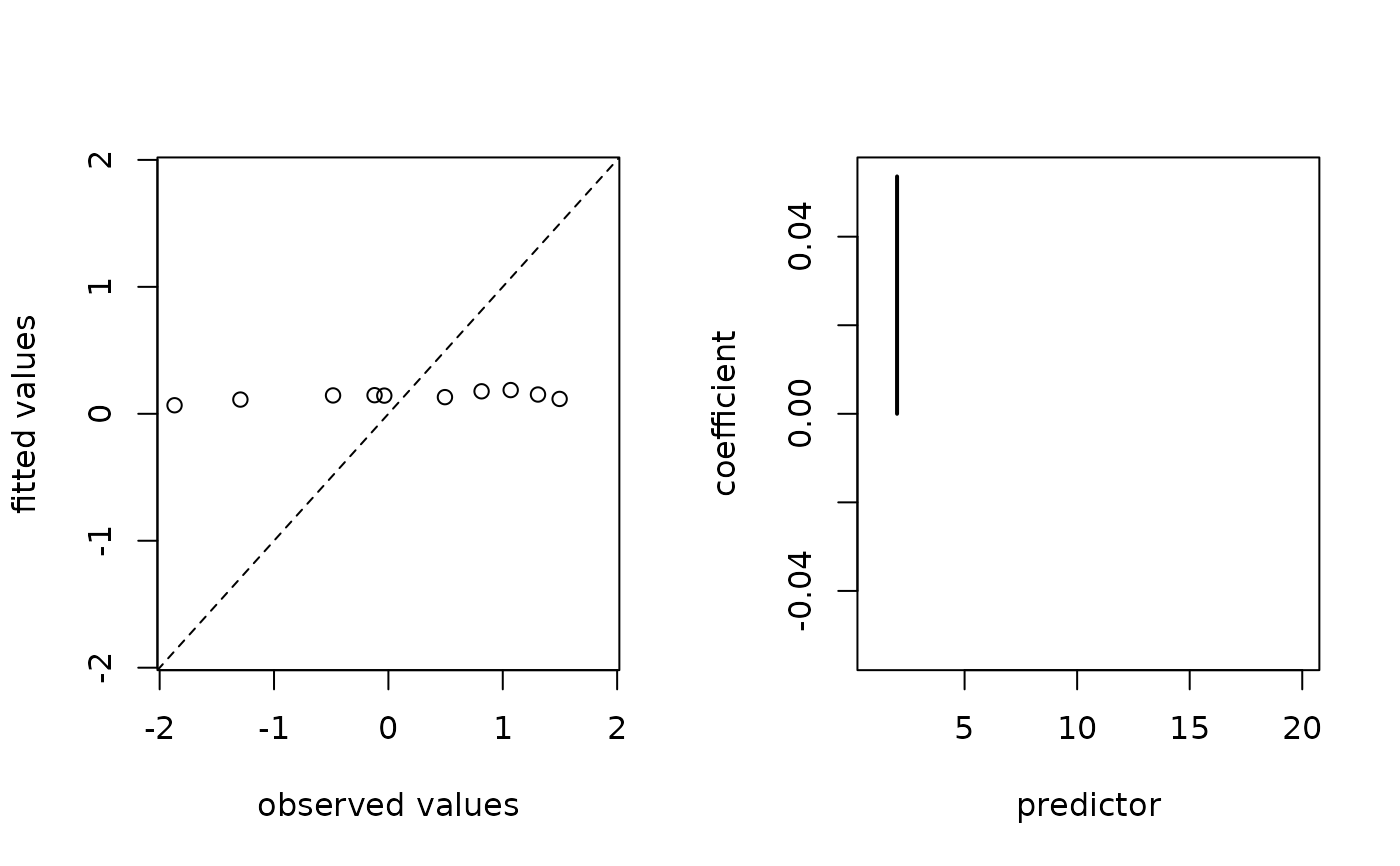
plot(object)
 print(object)
#> object of class ‘cv.corila’
#> (contains multiple objects of class ‘cv.glmnet’)
#> selected 0 from 20 predictors
summary(object)
#> --- object of class “cv.corila” ---
#> generalised linear model with gaussian family
#> 20 features (12 primary and 8 auxiliary features)
#> initial coefficients: ridge regression
#> final coefficients: adaptive lasso regression
#> optimised regularisation parameter: lambda.min = 1.218
#> selected weights: local = 0.2, global = 0.8
#> selected exponents: local = 0, global = 2
#> 1 non-zero coefficients (including intercept)
print(object)
#> object of class ‘cv.corila’
#> (contains multiple objects of class ‘cv.glmnet’)
#> selected 0 from 20 predictors
summary(object)
#> --- object of class “cv.corila” ---
#> generalised linear model with gaussian family
#> 20 features (12 primary and 8 auxiliary features)
#> initial coefficients: ridge regression
#> final coefficients: adaptive lasso regression
#> optimised regularisation parameter: lambda.min = 1.218
#> selected weights: local = 0.2, global = 0.8
#> selected exponents: local = 0, global = 2
#> 1 non-zero coefficients (including intercept)